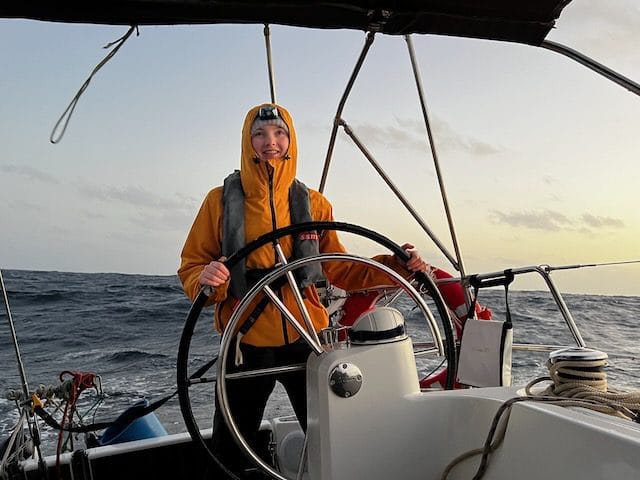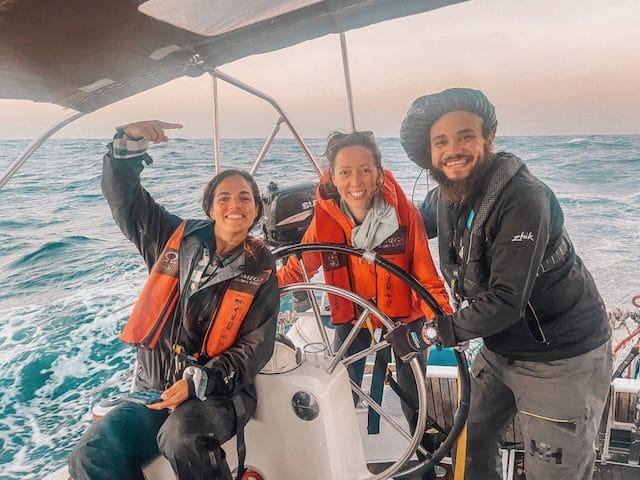
No, you do not need sailing experience to cross the Atlantic as crew. 51% of the 131 sailors in our Atlantic Crew Report had no real prior sailing experience before their first crossing. What you do need is a good attitude, reasonable physical fitness, and the judgement to choose the right boat and captain on shore. The captain teaches you the rest at sea. If you can’t do the boat-and-captain assessment yourself, join a crossing where someone you trust has already done it for you.
The single most common question we get from people who want to cross an ocean as crew: “do I have enough experience for this?” The second most common one: “do I need any experience at all?”
After ten years of running Ocean Nomads and 131 sailors deep into our Atlantic Crew Report, here is the answer, and then the longer version.
Do you actually need sailing experience to cross the Atlantic as crew?
No. You do not need sailing experience to cross the Atlantic as crew. Some of the best crew we’ve sailed with had never stepped on a sailboat before. Some of the worst had a Yachtmaster ticket. 51% of the 131 sailors in our Atlantic Crew Report had no real prior sailing experience before their first crossing. 39% found a boat and were on it within 10 days of starting to look.
What you do need is different, and we’ll walk through what actually matters and where inexperience genuinely becomes a risk.
Why does sailing skill matter less than you’d think?
A downwind Atlantic crossing in trade wind season is a lot of the same thing, hour after hour, day after day. The wind is behind you at around twenty knots. The autopilot does most of the steering. You take three or four hour watches, you keep a lookout, you check the sails, you write in the log, you make coffee. When something breaks, the experienced people fix it and you hand them the right tool. When it’s your turn to cook, you cook.
None of that requires you to know how to reef a mainsail before you get on the boat. The captain teaches you the ropes, sometimes literally, in the first few days out of the marina. By day four you can steer. By day seven you can trim a sail. By the time you make landfall on the other side, you’ve stood watches through the night in twenty-five knots and you’re a different person.
The learning happens on the boat, because it can only happen on the boat. Which is why so many first-timers cross the Atlantic and none of the sky falls.
What do captains actually want in Atlantic crew?
We’ve asked the captains we sail with this question. Here is the ranking, roughly in the order they say it out loud.
- Good attitude. Someone easy in a small space, doesn’t sulk when things break, doesn’t need managing. Named first, every time.
- Reasonable physical fitness. Hoist yourself out of a bunk in a rolling boat at three in the morning. Hang on to a rail when the boat lurches. You don’t need to be an athlete. You do need to move.
- Pulls their weight. Watches, cleaning, cooking, provisioning, fixing, listening. There is no such thing as a crossing where you don’t help.
- Basic self-care. Manages own seasickness, keeps kit tidy, showers when the water tank allows, doesn’t leave shoes in the companionway. Boat manners.
- Says what they don’t know. “I’ve never done this, please show me” is a green flag. “Yeah, yeah, I’ve got it” from someone who obviously has not got it is not.
- Sailing experience. Nice to have. Not on this list until number six for a reason.
Attitude, fitness, and pulling your weight. That is the whole first shelf. Everything else is a bonus.
I’d rather take three willing beginners than one experienced sailor who thinks they know everything.
A captain we sail with, veteran of nine transatlantics
Where does inexperience actually become a risk?
Here is the part that matters most. There is one place where lack of experience will get you into trouble, and it isn’t on the boat. It’s on the dock, before you sign up.
An experienced sailor walking down a marina in Las Palmas in November can smell a bad boat from three fingers away. They know what a life raft that hasn’t been serviced looks like. They can hear which captain is anxious in their voice. They notice the missing spare parts, the sagging rig, the rust on the shrouds, the cockroach in the galley. Two minutes on board and they know whether to keep the conversation going or make a polite exit.
A first-timer cannot do any of that. And that is the actual risk of crossing the Atlantic without experience: not that you can’t sail the boat, but that you cannot yet tell which boats are worth sailing on.
We’ve written a full breakdown of what goes wrong on Atlantic crossings, and it is almost always human. The wrong captain. The wrong crew mix. Money that wasn’t agreed upfront. Safety kit that wasn’t checked. If you’re weighing your first crossing, the seven red flags we check before stepping aboard walk through the warning signs and the boat I walked off hours before departure.
The three ways first-timers actually solve this
1. Do the boat and captain assessment properly, alone
Background check the captain. Video call before you fly out. Fly in early and spend three or four days on the boat before you commit. Ask other crews in the marina about the boat. Trust your instinct when something is off. The full framework is in Ocean Nomad, chapter 5, and the essentials live in the free Ocean Crew Safety Checklist.
Doable, yes. Takes time and self-trust that many first-timers underestimate, and doesn’t fully replace the pattern recognition a hundred sea miles gives you. Which is why option two exists.
2. Get some experience first, on a shorter passage
Do a shorter offshore leg before the Atlantic. A Biscay crossing, a Mediterranean delivery, a week with a sailing school, a rally leg from the UK to Portugal. You come back knowing how you handle four days out of sight of land, how you sleep in a rolling bunk, and how a boat behaves in twenty-five knots at three in the morning. A lot of our community members do exactly this before committing to their first ocean crossing. Our coastal trips are one way to take that step.
3. Cross with a boat and captain that people you trust already know
This is the reason Ocean Nomads exists. Someone with the pattern recognition has already done the boat and captain assessment for you. The safety checklist has been run, the agreements are in writing, the crew mix is chosen on purpose, and you show up as the first-timer you actually are. You still learn to sail on the way across. You just skip the shore-side gamble.
What happens on the boat itself if you’ve never sailed before?
Someone who’s never sailed before, joining a good crossing, follows a fairly predictable arc.
The first few days out of the marina you’re probably a little seasick and a lot overwhelmed. You watch what the experienced crew do and you copy it. You get shown the safety kit, you learn where the seacocks are, you learn the rules for going forward at night, you practise clipping on. Days three and four the queasiness lifts and you start doing more without being asked. By the end of the first week you have a watch partner, a bunk, a routine, a favourite mug, and a strong opinion about the coffee.
Somewhere around day ten you realise you’ve stopped counting the days. That’s when the crossing becomes yours.
Or sail with people we know
The Atlantic season is short. Boats leave the Canaries and Cape Verde from late November through early January, and the crew who cross with them mostly show up in the previous six weeks. If you’re seriously thinking about doing this, the decisions get made in autumn.
Our trips page lists the ocean passages and coastal trips we know and trust. See where we are sailing next, or join the network first for the member discount on every trip.
Common questions
Do I need any sailing certifications to crew across the Atlantic?
No formal certifications are required by law on most private yachts. Some commercially coded boats want a basic sea survival course or an STCW ticket, but the majority of transatlantic crew spots on private boats have no paperwork requirement at all.
How much sailing should I do before an Atlantic crossing?
None is possible. 51% of the sailors in our Atlantic Crew Report had no prior sailing experience. A few weekends on the water beforehand is comfortable. A shorter offshore leg, like a Biscay crossing or a Mediterranean delivery, is ideal.
Can I get paid to cross the Atlantic as crew?
Rarely, and usually only if you already have experience. Most transatlantic crew spots involve a daily contribution to shared costs, typically 5 to 25 euros a day. In our Atlantic Crew Report, 53% of surveyed sailors paid nothing for their crossing.
What if I get seasick on an Atlantic crossing?
Most people who get seasick get over it by day three or four. If you’ve never been offshore, a shorter test passage first is a good idea to find out how your body handles it. If seasickness is severe, an Atlantic crossing may not be for you, and there are lots of other ways to be at sea.
How do I find a boat to crew across the Atlantic as a first-timer?
Three main ways. Open listings (Crewbay, Findacrew, marina notice boards): high volume, quality varies. Rally crew lists such as the ARC’s: more structure. A network like Ocean Nomads: slower to join, faster to find the right fit because people who have sailed with the captain can tell you what the boat is like.
Is it safe for a beginner to cross the Atlantic?
Yes, if the boat and captain are right. The Atlantic crossing itself is one of the more benign ocean passages when sailed in the trade wind season (late November through early March). The risks that matter for a beginner are almost all on shore: choosing the right boat, the right captain, and the right crew mix.
Ocean Nomads is a community of sailors who cross oceans. This post was written from the collective experience of our members, the captains we sail with, our Atlantic Crew Report of 131 crossers, and Suzanne van der Veeken, Yachtmaster Offshore, five Atlantic crossings as crew, who wrote Ocean Nomad: The Complete Atlantic Sailing Crew Guide.
Come sail with us. 💙
New to sailing life? Start with the course
Zero to Ocean Nomad takes you from no boat and no contacts to your first ocean passage as crew. It covers finding a boat, checking the captain, preparing, and looking after yourself at sea.
More tips and tales to live a little wilder
- The Atlantic Crew Report: what 131 ocean crossers told us
- Travel across the Atlantic by sailboat: 10 tips for a happy and safe ocean adventure
- Coastal vs offshore sailing: which trip is right for you?
- From first sailing experience to single-handing his own boat in 3 months
- Why we created Ocean Nomads