Sailing across the Atlantic is one of the more benign ocean crossings you can do, if you go in the trade wind season (late November through early March) and you cross on a well-maintained boat with a captain you trust. Around 1,500 sailboats cross east to west each year. Storms are rare inside the window. The real risks are almost never the ocean itself. They are the boat you chose, the captain you trusted, and the agreements you did not put in writing. This is what our community of 131 Atlantic crossers has been telling us for ten years.
A while ago someone posted on r/sailing asking the internet for help talking his uncle out of a first-ever solo Atlantic crossing. Sixty years old, no formal training, forty kilometres of coastal sailing under his belt, a brand new untested boat, and the conviction that a satellite antenna and a good hull were enough. The nephew thought the family was going to lose him.
The thread went the way most of these threads go. Half the sailors piled on. Half told the nephew to relax, that a staged Med milk run would sort out most of it, that people cross with less experience than that all the time. Somewhere in the middle was a delivery skipper offering to jump on a call with the uncle for free.
At Ocean Nomads we’ve been running Atlantic crossings and collecting the stories from other crossers for ten years. I (Suzy, Yachtmaster Offshore) have crossed five times myself. Between the captains we sail with and the members in our network, we’ve watched hundreds of crossings unfold. In 2020 we started surveying every sailor we could find who had crossed the Atlantic as crew. That report is now 131 sailors deep. It’s the clearest picture of what actually goes wrong on an Atlantic crossing that we know of.
So the question of whether it’s dangerous to sail across the Atlantic keeps landing in our inbox in some form or another. Here’s our answer, pulled from the survey, from a decade of stories, and from the crossings we’ve run ourselves.
So is it actually dangerous?
Yes, it has real risks. No, the ocean is not the main one.
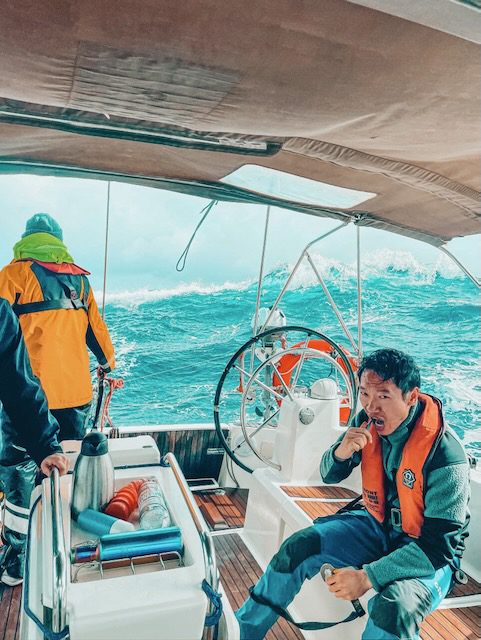
The weather on an Atlantic crossing is genuinely predictable inside the trade wind season. Most crossings from the Canaries or Cape Verde to the Caribbean are downwind sailing in twenty knots, day after day, with the boat rolling and the miles ticking off. Boats are more robust than most people think. If it’s a well-maintained boat with a competent captain and a crew that gets along, an Atlantic crossing is closer to a long camping trip than the storm-lashed nightmare Hollywood keeps selling.
Where the real danger lives is somewhere else. It lives in the boat you chose, the captain you trusted, and the agreements you didn’t put in writing. That’s what the sailing forums almost never talk about, and it’s the thing that has stopped more crossings, hurt more people, and drained more bank accounts than any weather system. 75% of the sailors in our Atlantic Crew Report said they’d do it again. Almost none of the ones who wouldn’t cited weather as the reason.
The weakest link on any Atlantic crossing is the human being.
A captain we sail with, anonymous by request
Perceived risks vs actual risks
When people ask us about danger they usually picture rogue waves and storms. When our crew talk about what actually went wrong for them, they name almost none of those things. Here’s the split, based on the 131-sailor Atlantic Crew Report and roughly a decade of stories from our community.
What people fear, and how often it happens in season
- A rogue wave capsizing the boat: almost never inside the trade wind window
- Hitting a container or a whale: extremely rare, one or two incidents a year across the whole ocean
- Getting caught in a storm: rare if you cross between late November and early March
- Falling overboard at night: preventable with tethers and clip-in rules that most captains enforce
- Pirates: not a factor on the standard trade wind route
- Getting lost at sea: essentially zero on a boat with GPS and a chart plotter
What actually goes wrong more often
- Choosing the wrong captain or the wrong boat
- Getting scammed out of a crew fee paid in advance
- Crew conflict on a 44-foot boat with nowhere to go
- An unseaworthy boat where the refit was not finished before departure
- A captain who takes unnecessary risks to save time or fuel
- Sexual pressure, usually aimed at younger women crew
The pattern in our data is clear. The ocean is not the problem. The people and the boat are.
What can actually go wrong on an Atlantic crossing
When I wrote Ocean Nomad in 2017 I sat down and listed the things that go badly on Atlantic crossings, based on my own experience and what dozens of crew had reported back. Nine years and 131 survey responses later, the list has held up. It’s shorter than you’d think, and none of it is a rogue wave.
- Scams. A crew spot that sounds too good to be true, money asked in advance, and a captain who is not who they said they were online. Members of our network have lost thousands of euros this way.
- Unstable behaviour. Alcohol, drugs, mental instability, uncontrolled anger. Fine on land where you can leave. Not fine at sea where you cannot.
- Sexual pressure. Usually aimed at younger women. Rare, but real. Every solo female sailor we know has a story.
- Illegal cargo. Yes, some boats do get used to move drugs or people across the Atlantic. Yes, you could get pulled into it as unwitting crew, and yes, this ruins your life.
- An unseaworthy boat. Refits half-done, safety kit expired, water tanks that leak, life rafts never serviced. A boat that was fine last season and is a disaster this one.
- Financial exposure. Getting ripped off, getting sued, or ending up liable for damage to a boat that isn’t yours because there was no agreement in writing.
You could be ripped off, sued, or sink. It happens. Don’t be too naïve to think it won’t happen to you. Sailors are a special breed, mostly in good ways, but not always. The single best defence against every risk on that list is choosing the right boat in the first place.
One of our founding stories: the boat I walked off
December 2014, Gran Tarajal, Fuerteventura. My last Facebook update to friends and family, hours before the boat was supposed to sail:
A broken water pump, bad weather, leaking hatches, last-minute crew changes, delivery issues, solar panel installations, Spanish mentality, lice. The Atlantic Ocean crossing boat had some delays. TODAY is the day we set sail, safe and sound, into the pond! Xmas at sea, New Year’s in the Caribbean! I’m super excited! We’re 8 people on a 44ft boat!
Me, hours before walking off SV The Bounty
Luckily, that’s not what happened. I did not cross the Atlantic on that boat. Neither did anyone else who was on board that day. Within a week the whole crew left, some voluntarily, some kicked off. Most had paid serious money in advance and got very little of it back. The boat eventually sailed across two months later. I ran into it again in Dominica later that year, with my old logo still stuck to the bow.
Here’s what I saw on that boat over the three weeks I was on board that, in hindsight, was the whole story. It’s the list we still hand people who ask us how to spot a bad boat.
- At the first meeting, the captain spoke badly about the rest of the crew, none of whom I’d met yet.
- Crew got swapped in and out in ways that were not okay. Over time, seven people were kicked off, most of whom had paid in advance and did not get their money back.
- The number on board kept climbing. When I signed up it was five people on a 44ft boat. Then six. Then seven. Then eight. Enough bunks, not enough storage for a month of food, not obviously enough water.
- The captain seemed too focused on the money. Every crew member was paying a daily fee on top of shared food, fuel and marina fees.
- The captain took unnecessary risks. He decided to sail out for fun in a storm that had been announced on the radio, because he “knew the area.” They ended up losing the oars and fuel tank off the dinghy, clinging to the mast to bring the sails down, half the crew throwing up. There was a Mayday on the VHF that night. It wasn’t a test that crew needed to run.
- The boat had been bought a few months earlier and was still being refitted. Nothing had been tested. New things kept breaking every day.
- The route kept changing. First via Cape Verde, then straight across. No clear reason, no way back once they left.
- The captain lived on Coke and Red Bull. Not our business what anyone consumes, but it does say something about the mental state you’re going to be sharing a boat with for three weeks.
- I was expected to share a cabin with the captain and do the same watch shifts. Our advice, always, no exceptions: distrust a captain who wants you in their cabin.
- Manipulative techniques to keep me on board. My logo on the boat. An offer to earn a few euros per crew member I helped recruit. Being kept away from the other crew by dinner invitations.
Any one of those in isolation might have been fine. The whole list stacked up was not. A 44ft boat is a small space for disagreements. Imagine it going tense mid-Atlantic, three weeks from the nearest port, no way off. Peace of mind is worth more than the sunk cost of the plane ticket, the provisioning money, or the pride of admitting the boat isn’t right.
I packed my bag and left. Two other crew who got kicked off the same day left with me. We rented an Airbnb. I still remember the intense feeling of freedom when I woke up on land the next morning. Two days later, the rest of the crew left too. The story escalated after that. Police, court, several of the youngsters lost thousands of euros they’d paid in advance.
Six weeks later I found another boat, Sea Ya, with captain Rudy and a small crew, and I crossed the Atlantic without incident. That’s when I started writing down what a good boat looks like, and what a bad one does. It became the guide that Ocean Nomad, and eventually Ocean Nomads as a community, was built on.
If we could give you only one piece of advice, it’s to always listen to your instinct. When in doubt, don’t do it. When you go for an ocean crossing, there is no turning back.
Ocean Nomad, chapter 5
One of our members lost a boat mid-Atlantic. Here’s what happened.
Eoin, one of our members, was sailing solo from the Azores toward Ireland when a storm hit. His boat went down 400 nautical miles from shore. A fellow member on land had been following his track on his Garmin inReach, raised the alarm, and coordinated with rescue services until Eoin was picked up and home safe.
Two things made the difference that day: an offshore communication device that worked, and someone ashore who knew his plan and his position. That’s a layer of safety no gear list shows: people who know where you are.
The reason we’re including this story, even though sinking is statistically rare, is that it happened to someone in our network who was on a boat that looked seaworthy on paper. It’s the strongest possible reminder that the boat check on shore is the crossing that matters most.
What other crew in our network wish they’d known
Over the years we’ve asked hundreds of Atlantic crossers the same question: what would you do differently if you could start again? A few of their answers, verbatim from the survey and from members of our community.
Believe more in what I feel when I meet the captain for the first time.
A sailor in our Atlantic Crew Report
You can find rides for 10 euros a day. It doesn’t have to be 25 euros a day. Don’t jump at the first opportunity, it’s your life.
A sailor in our Atlantic Crew Report
Take more time to cross with nice people.
A sailor in our Atlantic Crew Report
Get to know not only the captain but also the crew before doing the crossing.
A sailor in our Atlantic Crew Report
Only do financial dealings with the captain, not with the crew or any third party.
A sailor in our Atlantic Crew Report
Notice how few of those are about the ocean.
How do you actually stay safe on an Atlantic crossing?
Every one of the risks above shrinks dramatically if you put the work in on shore before you sail. Our safety framework, refined across ten years of crossings, is three steps.
1. Background check
Google the boat name, the captain’s name, the crew names. Look for media, court records, sailing forum posts, previous crew reviews. Check the captain’s social media, and if the timeline gets weird or aggressive, that’s your first data point. Once you’re in the marina, ask other boats. Sailing is a small world and everyone knows everyone. Inside our community, we also share notes on which captains and boats members have crossed with, so newer members don’t start from zero.
2. Real conversation before you fly out
Video call, not email. Talk to the captain, and if the captain is not the owner, talk to the owner too. Ask about experience, miles, refits, safety equipment, financial arrangements, the passage plan, whether it’s a dry boat or a wet one, watch schedules, what happens if the trip doesn’t work out. Don’t make it an interrogation, but do trust the way your body reacts to the answers.
3. Three days together before you commit
Never fly in and set sail the next day. Spend at least three days together on shore first. Fix things together. Go for a test sail. Have dinner with the crew. Boats get a foot shorter every day at sea. If you don’t like the way somebody chews on land, you will not like it in month three of a crossing that took longer than planned.
The full checklists are in Ocean Nomad, chapter 5, and the essentials are in the free Ocean Crew Safety Checklist if you want to walk aboard your first boat with a printed page in your hand.
The one thing to never override
Your instinct. Every time someone in our network has been on a boat that turned out badly, the feeling was there in the first hours and they talked themselves out of it. Every time a crossing went well, the feeling was also there in the first hours and they trusted it.
If you can’t come to a well-informed decision, or if something is nagging at you, don’t do it. No matter how desperate you are to cross the Atlantic, how much you might be paid, or how cool the boat looks on Instagram. Opportunities come along all the time.
Or cross with people who have done it
Ten years ago I stood on a marina in Fuerteventura wondering how anyone was supposed to figure out from scratch which captain to trust. That’s the reason Ocean Nomads exists.
For this season we put it all in the Atlantic crew toolkit: the routes and departure windows, the red flags and the questions to ask before you say yes, new boat opportunities every Monday, and a year in the network with people who have crossed before you.
See the Atlantic crew toolkit, or join the network if you’re not crossing this winter.
Common questions
Is the Atlantic crossing more dangerous than other ocean crossings?
No. Inside the trade wind season, from around late November to early March, a Canaries or Cape Verde to Caribbean crossing is one of the more benign ocean passages you can do. The Pacific is bigger, the Indian is rougher, the Southern Ocean is another category of thing entirely.
How often do storms hit Atlantic crossings?
Rarely, if you cross in season. Hurricane season officially runs until 1 November, and the last European lows track down through the same corridor into December. Most experienced crossers leave from late November through early January and see steady twenty-knot trades most days. You cannot outrun a storm in a sailboat, but you can plan to not be in one.
Do I need experience to cross the Atlantic as crew?
Depends on the boat. 51% of the sailors in our Atlantic Crew Report had no real prior sailing experience before their first crossing. What you do need is the judgement to choose the right boat, and that is a different skill entirely.
What’s the biggest risk on an Atlantic crossing that isn’t weather?
Human dynamics. The wrong captain, the wrong crew mix, or unclear agreements about money, watches and duties. Every crossing story in our network that ended badly ended there. Very few ended with a wave.
How long does it take to sail across the Atlantic?
18 to 25 days for the classic trade wind route from the Canary Islands or Cape Verde to the Caribbean. 21 to 30 days for the return via the Azores. Actual time depends on wind, boat, and route.
What’s the safest way to cross the Atlantic as crew?
Cross in season, on a well-maintained boat, with a captain and crew you’ve spent at least three days with on shore first. If you don’t want to do that assessment yourself, join a crossing organised by people who know the boat, the captain and the crew mix. That’s what we do at Ocean Nomads.
Ocean Nomads is a community of sailors who cross oceans. This post was written from the collective experience of our members, the captains we sail with, our Atlantic Crew Report of 131 crossers, and Suzanne van der Veeken (Suzy), Yachtmaster Offshore, five Atlantic crossings as crew, who wrote Ocean Nomad: The Complete Atlantic Sailing Crew Guide.
Come sail with us. 💙
Come meet your people
Boats welcoming crew, crew looking for boats, meetups when paths cross, and a map of sailors, vanlifers, hikers and basecamps in all the wild corners of the world. The people who say yes when you need a hand are inside.
More tips and tales to live a little wilder